
Art vs Capitalism
This is a sequel to my blog titled “Art as a public service” (although you don’t need to read it beforehand), taking the argument a little further and questioning the organization of our societies such as it is.
I’ve always been interested in literature, art and travels. When I was a kid it was a source of worry for my family and the school system. I was made to understand that these were not fields I could pursue as a “real” career because you could not live off it or at least not well.
In schools and colleges when budgets are tight, the subjects deemed worth cutting are art, music, languages, philosophy, literature and so on. Mathematics, computer science and biology are the last ones to get cut. But why? Art and humanities are in my opinion what make life worth living, so why do we look at these subjects with disdain? Why the different treatment? Some subjects are seen as crucial to a child’s future and the others a side subject, a finishing touch on an education mainly focused on helping you find a job.
Our society is so infused with capitalism that at this point, any educational endeavor that does not lead to a career seem futile. As if our goal in life, our destiny, our higher purpose was to find a job! Mathematics and science are worth pursuing because they make you more employable... Learning French or Italian? Studying philosophy? Bleh!
Our societies were built on pillars like literature, philosophy, fine arts, architecture, religion and so on, they gave us democracy and the Sistine Chapel yet we’re ready to throw it all out for a dependable paycheck. The fact is that we need money to survive. As a result, every adult who doesn’t devote their full time energy to earning as much money as they can is seen at best as an oddity and at worst as a failure. Learning to watercolor can wait for the weekend.
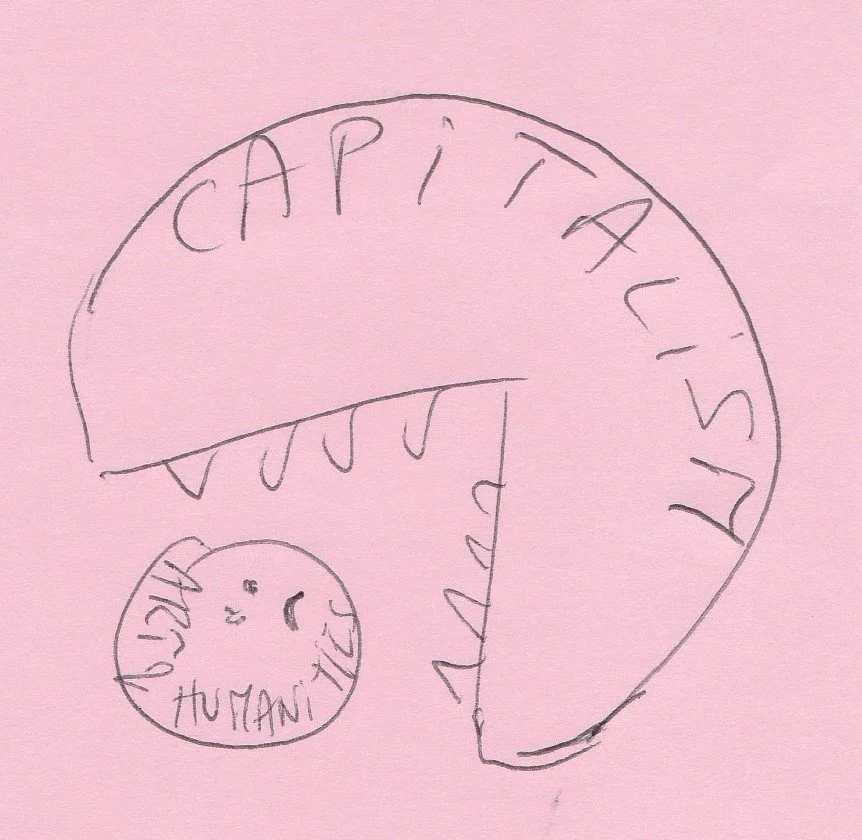
Capitalism is eating Art and Humanities (and don’t make fun of my drawing skills!)
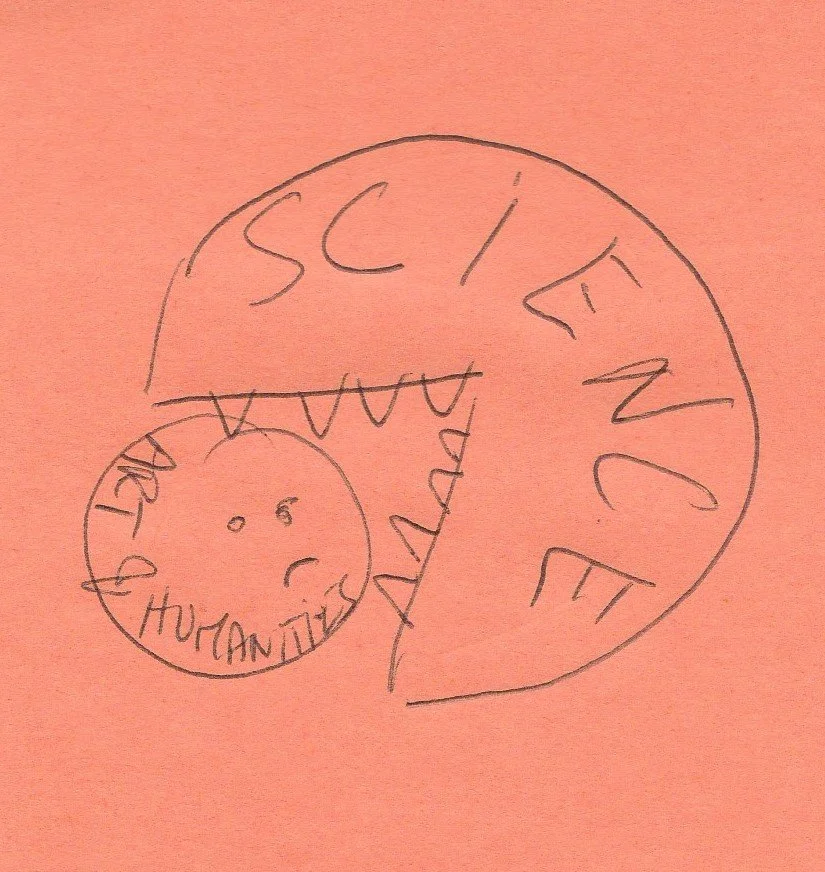
Science is eating Art and Humanities in the education system
Why does it matter? Let me count the ways….
First, we need to feed our belly but we also need to feed our brains and spirit. If we don’t leave space in our life for both, we are making ourselves miserable. Mental health issues have never been higher, especially in the younger generation, and I would bet our single focus on making money and finding a job is partly to blame. There are some things you can’t buy. When one in two people are supposedly affected by poor mental health, the issue is not with the individual but with the system we exist in.
The pace of modern life- being productive at all costs and never taking a break -is making us incapable to find the right balance, to feed the belly and the brain at the same time. I am sure some people love their jobs and make huge amounts of money at the same time but they’re the exception. People need to create, to socialize, to exchange ideas in order to be happy, and our society won’t give us the time to do this.
Art therapy is a thing because we don’t leave enough space for art, people and ideas in our lives and that makes us sick. Instead of using it as a cure, let’s use it as a prevention method: slow down and do something you enjoy, read a book, take a pottery class, sign up for the community musical, organize a neighborhood potluck.
Some people will argue that it is art that makes you crazy. They name Vincent Van Gogh or Camille Claudel as exhibit A and B. I think it’s the other way round: people who were feeling bad in the first place started creating art in order to feel better. It worked until it didn’t. But it’s not a coincidence that “unconventional” people gravitate toward art. They need it to survive. We all do. Beaux-arts magazine in France shared a survey in February 2026 showing that 64% of French people like contemporary art and 62% have an art practice. I would be curious to find out the results for other countries. My impression is that the practice of art is not marginal. It’s a widespread survival strategy.
The second issue is that by encouraging everyone to study certain subjects and not others, we’re making our society sick. It’s not a fluke that unfettered capitalism and far right ideas have been spreading alongside each other. By cutting down on educating people about fundamentals ( they’re the foundation of our cultures) like philosophy, literature, art, languages because they’re not “marketable skills” we are making humans less able and likely to think deeply and question the system. It’s easier for them to become preys to simplistic ideas that have been proven, not only morally wrong , but just plain bad for everyone involved. There is always a price to pay (we can’t escape capitalism, even in our expressions!) when you spread racism and violence. Art and humanities teach you an appreciation of the world and humans such as they are, and NOT how they can be used to make a profit. They open your mind to different ideas and different ways of thinking. They’re fundamental if we want to live in a peaceful society.
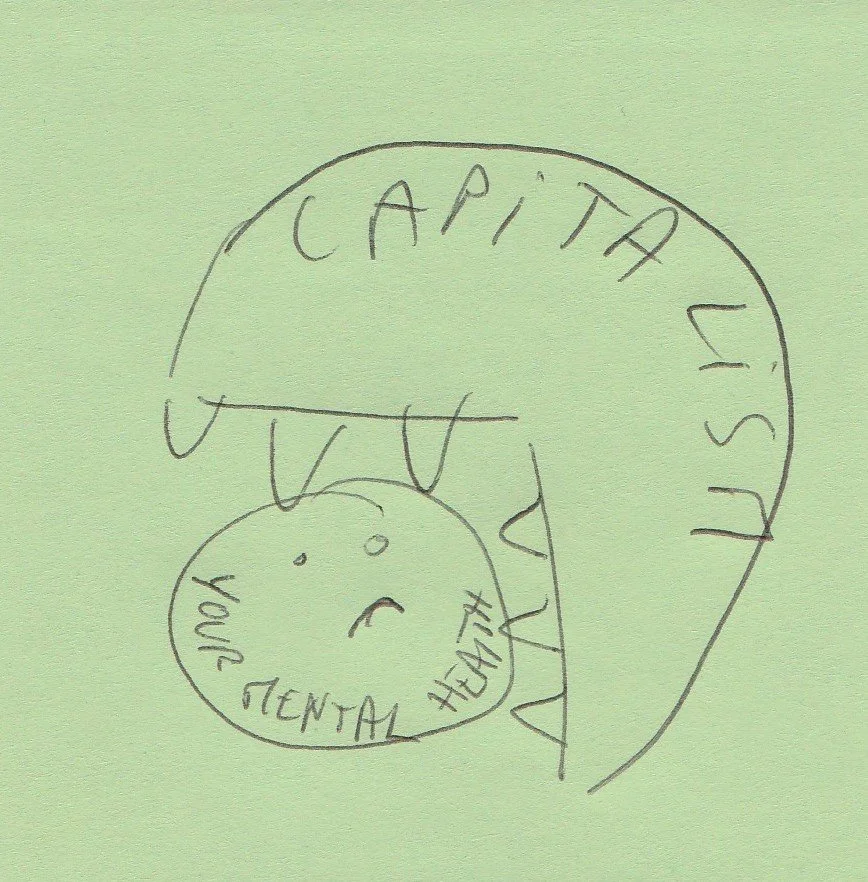
Capitalism is eating your mental health
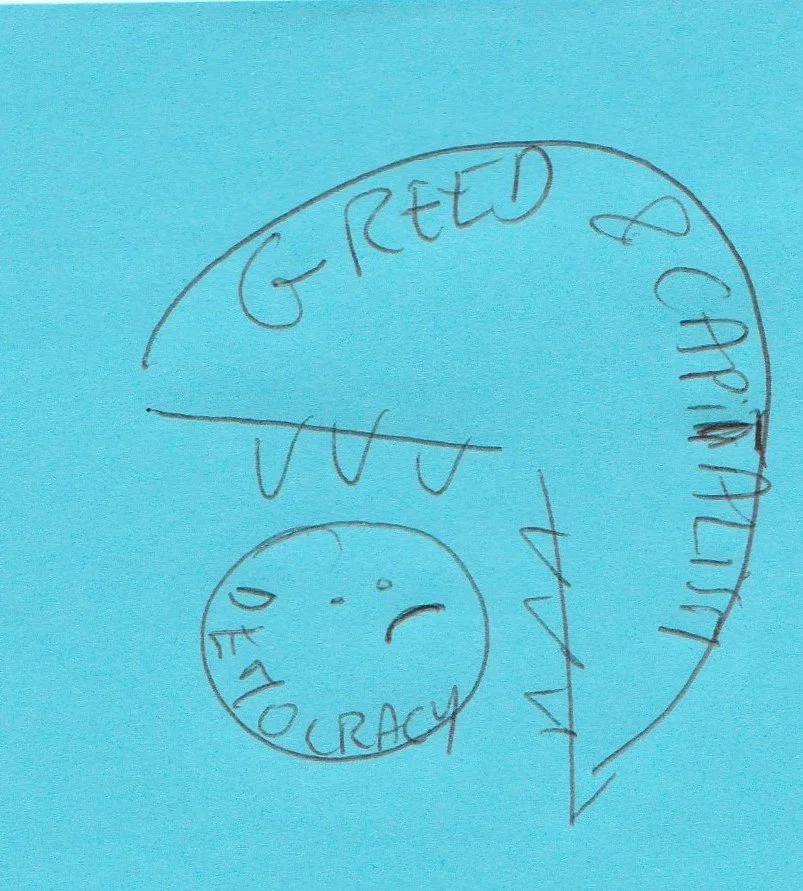
Capitalism is eating democracy
The third issue with art and humanities surviving in a capitalist society is that we’re trying to make them fit in an environment that is not meant for them. Trying to market your art is like putting a round shape in a square hole. It doesn’t fit. Art is not meant to be sold, it’s an individual expression of the self that doesn’t care about anything except the process of creating and the endorphins you get from creating art . Yes, there are people who make money with art, but it’s not the point. Money or flattering your ego is not the goal of art creation. Similarly, humanities is about knowledge, learning and exchanging ideas. It’s not about making money. You can as long as you’re not greedy, mostly by teaching because we still do remember that these skills are important to pass on, even if we forgot why.
I am not saying that you shouldn’t try to sell your art, but it’s a different beast with different rules. Being an artist is easy. If you meaningfully create something, whatever it is, however big or small, you are an artist. You don’t need to share it with anyone. You don’t even need to be good at it.
Selling your art, on the other hand, happens in a different system, where things have value, and people need to agree on the value of something to exchange money for it. Creating is its own reward and you shouldn’t expect anything. No one owes you to like your art or pay money for it. But you don’t owe them anything either, that’s artistic freedom!
I once followed an online class aimed at emerging small businesses. I was asked to “define what problem you’re trying to solve with your business” and I felt really stupid. My answer was: “not enough art in the world” and I stand by this, but any art would do, it doesn’t have to be mine. It made me realize how far apart art and business are from each other.
As a result of thinking art has to somehow be exchanged for money, many artists feel miserable. So many artists on Instagram complain that they’re not making ends meet, that market booths are too expensive and sell cheap crap from Shein when their craft takes years or learning and months of making. I get it, I totally do. Another complaint I heard from artists and makers is that “non-professionals” flood the market with cheap prices because they don’t need to make a living. Marketing your art is something you’re always going to do in an hostile environment. People need art but they don’t necessarily understand why and might not need YOUR art. Nobody owes you anything, they don’t owe you to like your art, buy it or sell their own art at a specific price so yours will sell better. If you change the stuff you make so people like it and buy it, it’s not really YOUR art any more. It doesn’t mean you shouldn’t, but be aware that artists get burned out doing this. Keep some of your art practice away from the markets and keep experimenting.
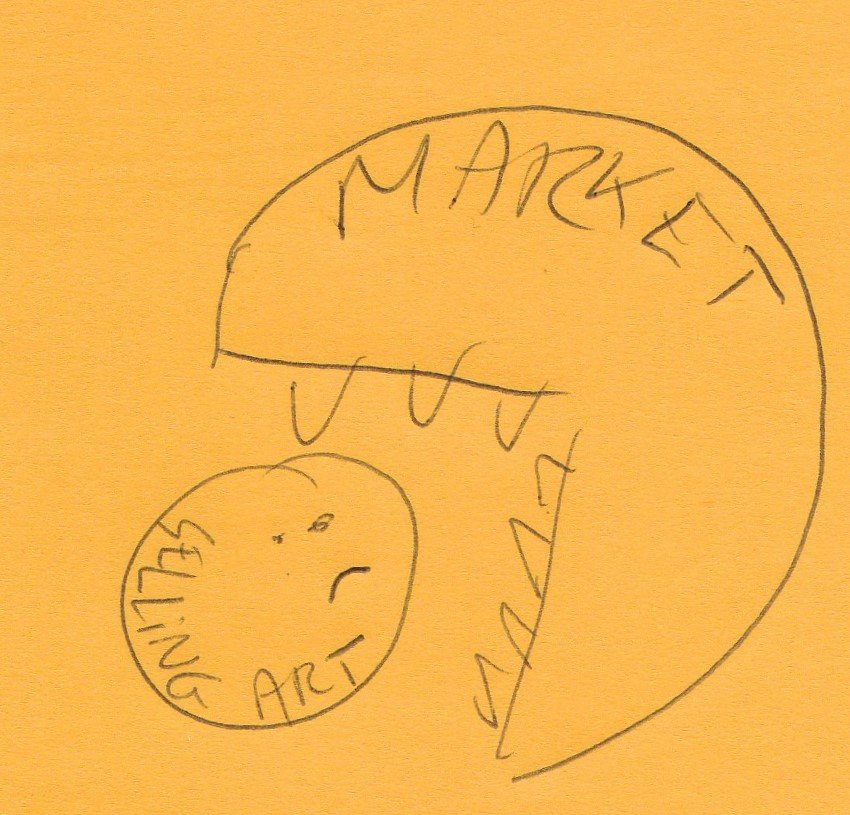
It’s hard work to sell your art work
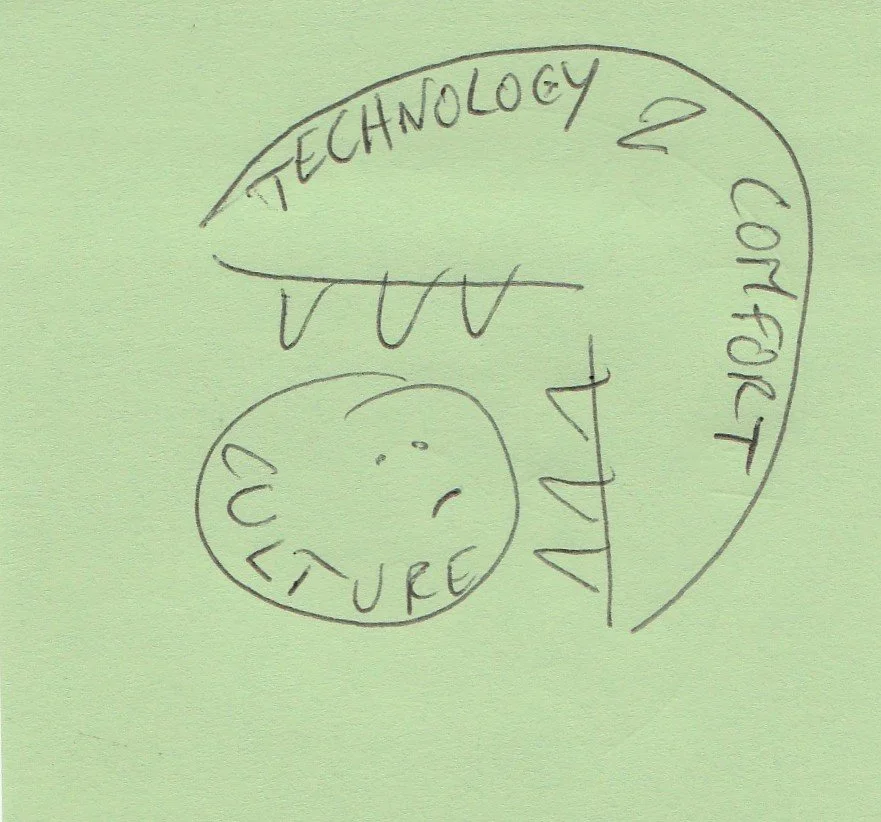
We want central heating and smart phone, but we’re at risk of destroying our cultures that date back thousand of years in order to achieve this goal.
There is one last point I want to make: one of the byproducts of thinking everything should be marketable is that art and humanities are often seen as elitist. It’s hard to carve enough time out of your day to write poetry or have deep conversations about the meaning of life when you’re juggling two jobs. Vincent Van Gogh was quite poor but he could spend all his time painting because he was subsidized by his brother. Art and ideas are the prerogative of the (relatively) wealthy. As an example, this article says that only 8% of UK artists come from working class backgrounds. (https://www.artshub.co.uk/news/news/only-8-of-uk-artists-come-from-working-class-background-2557200/). Similarly, poor people are underrepresented in PTA organizations and local elections for example. It is unfair, and it means that our art and our community do not represent people as a whole, just the wealthiest half. Money should not be a prerequisite to dabble in art or ideas.
So what now? How do we fix this?
Ireland created the buzz recently by launching an income for artists in recognition of the work they do for their country. It is limited to 2000 people right now, but it is going in the right direction. I like the idea that we can rethink what it means to work. Working shouldn’t just mean making money. Stay at home parents and some volunteers work harder than anyone I know and don’t get paid. If everyone who does unpaid work stopped, our society would come to a standstill. It is already a problem as more and more people (i.e: women) are working and all the unpaid labor they used to do is shared by less and less people. Volunteer organizations are struggling. I am not saying that women shouldn’t work. I am saying that we should all work less so we can take care of our families, our communities and our mental health. Maybe a universal income is the solution.
Governments give tax breaks to rich people all the time because they hope they will somehow create jobs and that will be good for the community. So they basically give them money. Why not try to give normal people money in the hope they will create a masterpiece or come up with a great new business idea they haven’t had the time to think about and will make society better?
As a side note, I find it interesting that so many billionaires who should be the poster boys and girls of capitalism are really excited about sharing their art collection or encouraging art creation with their money ( Pinault Foundation, Louis Vuitton Foundation and Bettencourt foundation in France; Jordan Schnitzer Family Foundation in Oregon and I am sure there are many many more.) It’s like admitting that wealth is not the answer to their needs, that money doesn’t make you happy but art does, that maybe they feel guilty about all the wealth they accumulated through capitalism and are trying to atone by giving back through art.
I can imagine you rolling your eyes at my ideas about universal income. People will call me deluded, with pink-tinted glasses. They think that there is just not enough money to go around. Yet there is plenty of wealth in the world and this wealth was not created in a vacuum.
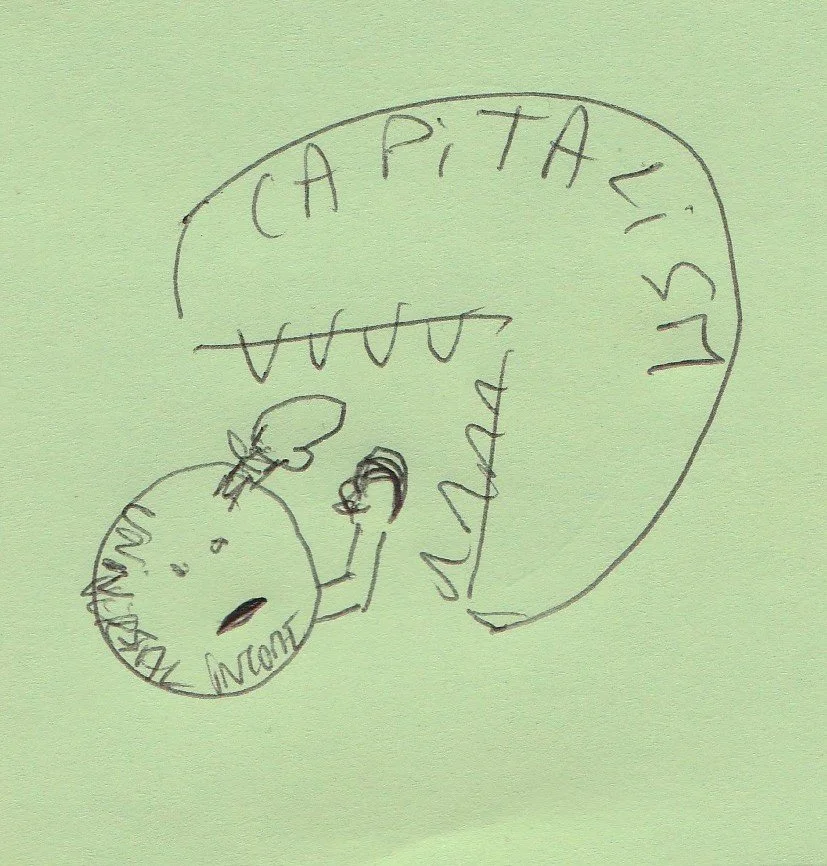
Fighting back with universal income (yes, I know my drawing skills are terrible… Still, a picture is worth a thousand words.)
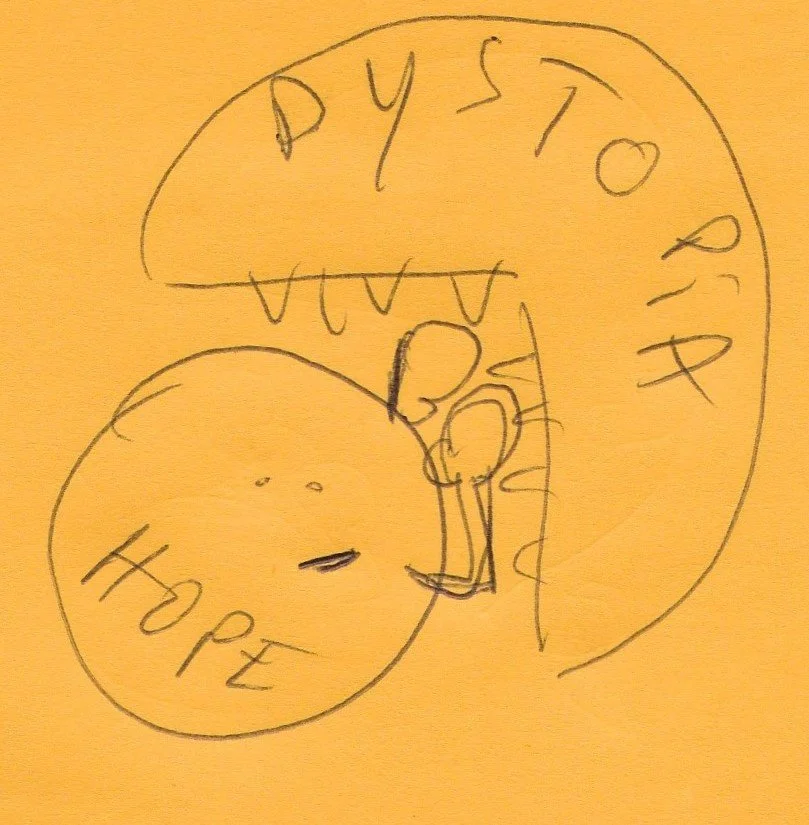
Fighting back with hope.
I love to imagine that we could somehow come up with an alternate economic model that is not based solely on money but also on exchanging art and ideas. I won’t apologize for being an optimist. It’s easier than ever to share bad news. Fascism is rising and the environment in shreds, but I believe we can do better. Thinking everything is doomed is a way for the system to avoid questioning and reform. It takes energy and hope to change things.
The optimists have a hand to play. People know they’re not happy and want to try something different but get offered the same thing from all political parties and the same kind of money-infused dreams. Now is a good time. Genders are being redefined. Male/female relationships are being redefined. Why don’t we take the chance to redefine the organization of our societies too? Renewable energies can help. Even AI can help if you are not worried about losing your job to AI, but instead get AI to do the boring jobs while we do what we actually enjoy doing.
Why is utopia always unrealistic while dystopia is so common in sci-fi movies? Where is the anti Hunger Games where all the kids go to school to create and learn what they love, and not what they’ve been told will get them a job? Sure, the movie would be boring but I can’t imagine a better society to live in than the one where people are actually passionate about what they do.